State Aid: The CISAF After Its First Year: What Have We Learned?
The EU State aid rules have shifted over the past decade. From traditionally placing tight limits on targeted investment aid, the State Aid framework has now been adapted to give Member States more room to support investments in innovation, the green transition, and strategic industrial projects.
Key Takeaways
- The Clean Industrial Deal State Aid Framework (CISAF) was adopted and became applicable on 25 June 2025 and remains in force until 31 December 2030. It makes part of the Temporary Crisis and Transition Framework (TCTF) permanent and widens the range of aid options and eligible technologies.
Uptake of schemes under the CISAF is uneven: 16 Member States have obtained approval for a total of 32 aid schemes under the CISAF, with Spain, France, Italy and Austria accounting for half of the approved schemes. Sweden, Finland, and the Baltic States are among the countries with no scheme approved so far. - The largest approved schemes support renewable energy production, including a EUR 63 billion French offshore wind scheme and a EUR 23 billion Italian scheme, both using two-way contracts for difference (CfDs). The most common type of scheme supports investment in clean technology manufacturing, with budgets ranging from EUR 6 million to EUR 4,100 million.
- France’s C3IV tax credit scheme offer early evidence of impact: 73 projects have received aid since 2024 and are expected to trigger 22 billion of industrial investment by 2030. The CISAF extension with a budget of EUR 1,100 million, is expected to support around 40 additional projects.
- The CISAF reiterates that not all State investments constitute State aid. Public co-investment on market terms, such as equity stakes in green industrial projects, therefore offers an alternative to aid, provided market terms are documented before the investment decision.
Frequently asked questions
What is the CISAF and when did it enter into force?
The CISAF was adopted and became applicable on 25 June 2025. It replaces the TCTF and remains in force until 31 December 2030. It carried over and extended elements of the TCTF, added new aid options, and widened the range of eligible technologies.
How many Member States have used the CISAF so far?
Since its entry into force, 16 Member States have obtained approval for a total of 32 aid schemes under the CISAF. Spain, France, Italy and Austria account for half of the approved schemes. Other countries with more than one scheme are Czechia, Denmark, Germany, and Slovenia. Sweden, Finland, and the Baltic States are among the countries with no scheme approved so far.
What types of schemes have been approved under the CISAF?
Three broad categories have emerged: schemes supporting renewable energy production (the largest in budget, using two-way contracts for difference), schemes easing the impact of high electricity prices on energy-intensive companies, and schemes supporting investments in clean technology manufacturing, which is the most common type.
Does public co-investment always count as State aid?
No. The CISAF reiterates that not all investments by the State constitute State aid. When the State acts as a market economy investor, it can co-invest alongside private parties without this constituting State aid, provided the investment is made on market terms as assessed under the market economy operator (MEO) test.
Main article
Background
The EU State aid rules have shifted over the past decade. From traditionally placing tight limits on targeted investment aid, the State Aid framework has now been adapted to give Member States more room to support investments in innovation, the green transition, and strategic industrial projects.
Last year, on 25 June 2025, the CISAF was adopted and became applicable, which took this shift a step further. The CISAF, which replaces the TCTF and remains in force until 31 December 2030, carried over and extended elements of the TCTF, and added new aid options and widened the range of eligible technologies. Like the TCTF, the CISAF puts particular weight on aid for capital-intensive green industrial investments.
The CISAF has now been in place for more than a year. In this post, we look at how Member States have used it so far and what to expect next.
Uneven Uptake Across Member States
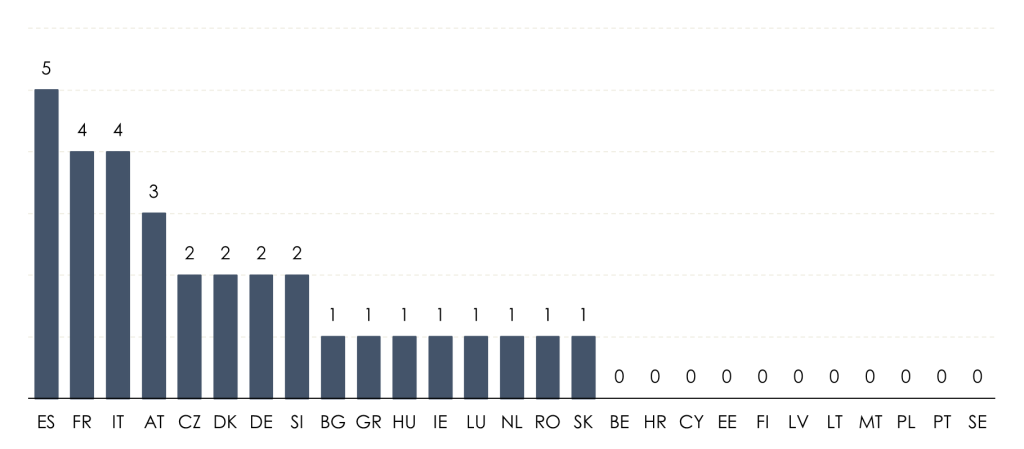
Since its entry into force, 16 Member States have obtained approval for a total of 32 aid schemes under the CISAF. Spain, France, Italy and Austria account for half of the approved schemes. Other countries with more than one scheme are Czechia, Denmark, Germany, and Slovenia. Sweden, Finland, and the Baltic States, are among the countries with no scheme approved so far.
Figure 1: Number of aid schemes approved under the CISAF
Number of schemes
Source: The European Commission’s Press Corner, link.
Scheme sizes can vary considerably, mainly depending on the scheme’s objective. The largest schemes that have been approved support renewable energy production. For example, in July 2026, the Commission approved a EUR 63 billion French scheme running for 25 years for the construction and operation of eleven offshore wind farms, and in June 2026, a EUR 23 billion Italian scheme for renewable energy production such as onshore wind, solar, and hydropower. Both grant aid through so-called two-way contracts for difference (CfDs): the beneficiary receives the difference when the market price falls below the strike price, and must pay back the difference when the market price exceeds it. Their large budgets reflect long contract periods of 20 years in Italy and 25 years in France.
A second group of schemes has been set up to ease the impact of high electricity prices on energy-intensive companies. A few Member States particularly exposed to volatile electricity prices have set up schemes for this purpose.
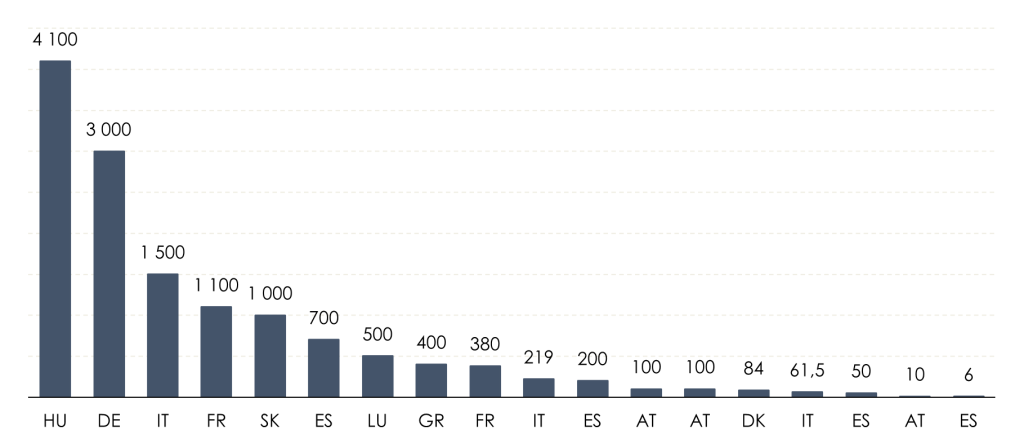
The most common type of scheme is designed to support investments in the manufacturing of clean technology. Typically, under these schemes, projects that meet the eligibility criteria can apply for aid up to fixed caps. Budgets in this group range from as small as EUR 6 million to EUR 4,100 million.
Figure 2: Budgets of CISAF schemes supporting clean technology manufacturing
Million EUR
Source: The European Commission’s Press Corner, link.
A Closer Look at France’s Tax Credit Scheme
One scheme approved under the CISAF is particularly interesting for assessing the (still early) impacts of the approved schemes. France’s C3IV scheme was previously approved under the TCTF in 2024. It was then extended under the CISAF (with a budget of EUR 1,100 million), and the extension entered into force in August 2026.
The scheme offers investment aid in the form of tax credits that are offset against corporate tax or paid out directly (in the absence of taxable income) based on investment costs actually incurred. Aid intensities and caps depend on where the project is located:
- 15% of eligible costs, up to EUR 150 million per project, outside assisted areas;
- 20% of eligible costs, up to EUR 200 million per project, in assisted ’c’ areas; and
- 35% of eligible costs, up to EUR 350 million per project, in assisted ’a’ areas.
Aid intensities can be increased by an additional 20 percentage points for small enterprises and 10 percentage points for medium-sized enterprises.
According to the French government’s status reporting on the scheme , 73 projects have been granted aid so far. Together, they are expected to trigger EUR 22 billion of industrial investment by 2030. The extension is expected to support around 40 additional projects, generating EUR 8 billion in investments and 20,000 direct jobs.
The French design is both transparent and available to a broad set of companies. Aid payments are reserved for projects that follow through on their investment decisions. Projected tax credits amounted to EUR 140 million for 2025, and the French government expects the same amount in 2026.
An Overlooked Option: Public Co-Investment on Market Terms
In its introduction, the CISAF reiterates that not all investments by the State constitute State aid. When the State acts as a market economy investor, it can co-invest alongside private parties without this constituting State aid.
This means that public co-financing can be a catalyst for private investment, not an obstacle. While the option is not new, several Member States have in the last year taken equity stakes in green industrial projects.
Examples include Germany’s state-owned development bank KfW investing EUR 150 million for a 14% equity position in Vulcan Energy, which is developing its Lionheart geothermal lithium project in the Upper Rhine Valley. Spain’s government investment fund COFIDES recently committed EUR 150 million to an equity position in Hydnum Steel to help finance its clean steel plant in Puertollano. Italy’s public development agency Invitalia has invested EUR 29 million for an equity stake in Italian Green Factory, to reindustrialise a former Whirlpool site in Naples.
In this respect, companies and public bodies must be aware of the State aid considerations for such co-financing. The key concept is ’market terms’, assessed using the so-called market economy operator (MEO) test which has been established by the EU Courts. The test asks whether the public body co-investing acts as a private investor would in comparable circumstances. If it does, the investment confers no economic advantage and falls outside the definition of State aid.
Market terms should be documented in advance, e.g. on the basis of pari passu terms alongside private investors or through ex ante profitability analysis. In practice, this means assessing the scope for co-financing early and preparing the evidence before the investment decision. For the public investor, this offers an alternative to aid, where the gains typically include transparency, influence, and a share of future returns.
What Can We Expect for the Future?
As described, several Member States already use the CISAF actively to boost green industrial investments, but uptake is uneven and it is still early to evaluate the impact of the schemes.
Policymakers still need to predict whether schemes are likely to change investment decisions, and which options could suit their own Member State. Companies, on the other hand, need to consider early on how the CISAF fits into the financing of their projects. Eligibility conditions and aid levels can shift where an investment is located or make a project profitable enough to reach a final investment decision.
For capital-intensive industrial projects, we highlight two options with potential to grow in importance: expenditure-based tax credits and public co-financing on market terms. The CISAF adds another piece to an evolving State aid landscape, and both public and private actors should engage with the opportunities it creates.
- https://www.entreprises.gouv.fr/espace-presse/le-credit-dimpot-au-titre-des-investissements-dans-lindustrie-verte-prolonge-pour
- Communication from the Commission – Framework for State Aid measures to support the Clean Industrial Deal (Clean Industrial Deal State Aid Framework), C(2025) 7600 final, OJ C, C/2025/3602, 4.7.2025, §7, footnote 4.
- https://announcements.asx.com.au/asxpdf/20251203/pdf/06sw9f4qfsq1tn.pdf
- https://www.cofides.es/noticias/notas-de-prensa/cofides-compromete-150-millones-euros-hydnum-steel-para-construir-primera
- https://www.mimit.gov.it/it/notizie-stampa/ex-whirlpool-perfezionato-ingresso-invitalia-in-italian-green-factory-via-al-rilancio-industriale-dellarea
Authors
Elisabeth Eklund, Partner, Advokatfirman Delphi
Victor Ahlqvist, Senior Economist, Copenhagen Economics